
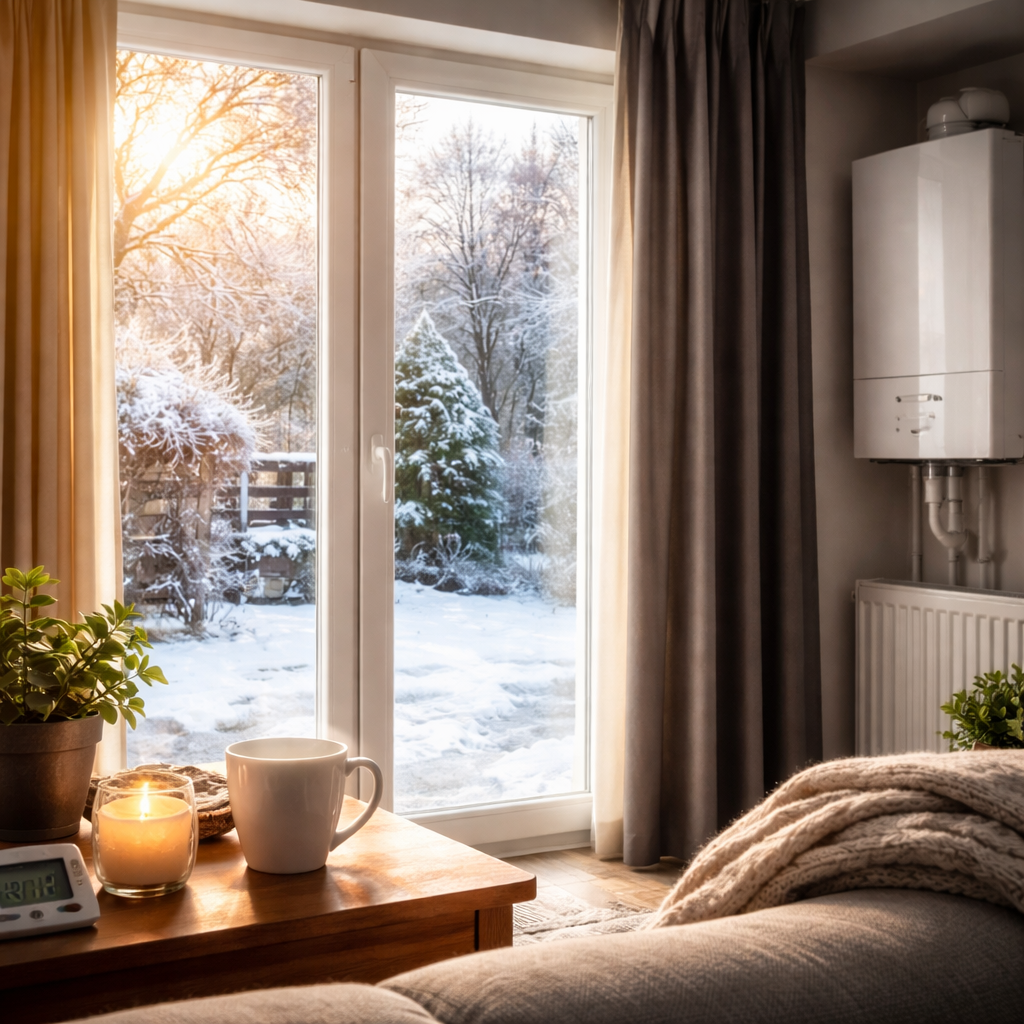
With a cold snap due over the coming days, it’s worth doing a few simple things now to keep your home warm, prevent frozen pipes, and reduce the chance of boiler issues.
A little prep can save a lot of hassle and if something does go wrong, there are a couple of safe checks you can do before calling for help.
1) Use your curtains properly (it really works)
Your windows are one of the biggest sources of heat loss but you can also use them to your advantage:
North-facing windows: keep curtains or blinds closed (these windows get less sunlight and lose heat quickly).
South-facing windows: keep curtains or blinds open during daylight to let in free heat from the sun, then close them at dusk to trap warmth in.
If you have thick curtains, even better they make a noticeable difference.
2) Quick, sensible steps to prevent frozen pipes
Frozen pipes can cause catastrophic leaks, loss of water pressure, and boiler breakdowns. A few basics:
Keep your heating ticking over in very cold weather (even low-level heating helps).
If you’re away, don’t turn the heating fully off — set it to a low temperature of 12 to 15 degrees
Know where your stopcock is (so you can quickly shut off the water if needed). Finding it ahead of time will help massively if the worst was to happen.
A big winter culprit of boiler breakdowns is the condensate pipe (more on that below), especially if it runs outside or through an uninsulated area. Which? notes that freezing temperatures often trigger issues like frozen condensate pipes and low boiler pressure.
3) Boilers in cold weather: what usually goes wrong
Most modern boilers are “condensing boilers”. They create a small amount of waste water (condensate) that drains away through a plastic pipe to an outside drain. In freezing weather, that pipe can ice up and cause the boiler to stop as a safety measure. Worcester Bosch notes this is a common reason boilers stop in freezing temperatures and it’s often something you can resolve safely yourself. Worcester Bosch
Signs your boiler may be struggling
Boiler stops working / no heating or hot water
Gurgling sounds from the boiler or pipework
An error code appears (examples below)
4) Frozen condensate pipe: the error codes to look out for
Different boiler brands show different codes. These codes don’t always guarantee the condensate pipe is frozen — but in a cold snap, they are common indicators.
Here are some of the most frequently reported ones associated with condensate freezing:
Worcester Bosch
EA 227 (often appears as 227) – commonly linked with frozen condensate pipe in freezing weather.
EA 229 (often appears as 229) – can also show during cold spells when the condensate pipe is frozen.
Vaillant
F28 – Vaillant’s own guidance notes this can be caused by several issues, including a frozen condensate pipe.
F29 – often appears alongside similar ignition/flame-related issues in freezing weather.
Ideal
L2 – commonly linked with frozen condensate pipe during cold spells.
Some Ideal models may show F2 or “flame failure” messaging in these situations.
Other makes (varies)
Some manufacturers show a general flame/ignition fault where a frozen condensate pipe can be one of the causes (especially in freezing weather). Which? highlights frozen condensate pipes as a frequent winter issue across boilers generally. Which?
5) How to safely defrost a frozen condensate pipe (if you’re comfortable)
If your boiler has stopped and you suspect the condensate pipe is frozen, this is a common safe approach used by manufacturers:
Step-by-step
Turn your boiler off (or set it to reset/standby).
Locate the condensate pipe
Usually a white or grey plastic pipe that leaves the boiler and runs outside to a drain.
Warm the pipe gradually
Pour warm (not boiling) water over the outside section of the pipe.
A warm cloth or hot water bottle can also work.
A warm hair dryer can melt the blockage fast.
Reset the boiler
Once thawed, reset the boiler and see if it fires back up.
Important safety notes
Do not use boiling water directly (risk of damaging plastic pipework).
Do not dismantle the boiler casing.
If you’re unsure, stop and report the issue.
If it keeps freezing
It’s often because the outside section is long, exposed, or uninsulated. A longer-term fix is insulating (lagging) that external section and improving routing but we can arrange this where appropriate.
6) What else to check before reporting a boiler issue
If the heating goes off, it’s worth checking these quick things:
Check boiler pressure
Low pressure is a common winter issue. If your boiler pressure has dropped significantly, it may need topping up. Which? lists loss of boiler pressure as one of the typical cold-weather problems. Every boiler is different when it comes to the location of your filling loop and how to operate it, however there are fantastic videos on places like YouTube that will show you what to look for and what to do. Knowing how to top up your boilers pressure will often be one of the best things to know how to do to fix issues that arise when a boiler is in demand more than normal.
Check your thermostat and programmer
It sounds obvious, but many “boiler failures” turn out to be:
thermostat batteries flat
timer settings reset after a power cut
programmer switched to “off” or “hot water only”
7) When to contact us (and what to include)
Please report it to us if:
You’ve tried the steps above and the boiler still won’t run
There’s no heating and no hot water
You can see a leak or water coming through ceilings/walls
You smell gas (in that case: call the National Gas Emergency Service on 0800 111 999 immediately, then let us know)
When you report it, please include:
the error code on the boiler
whether you have any hot water
whether your boiler pressure is low
a photo of the boiler display (if possible)
This helps us diagnose quickly and reduce delays.
8) A few extra cold snap tips (simple, but effective)
Keep radiators clear (don’t block them with furniture and clothing)
Use draft excluders if you have them
Run taps briefly if a room is extremely cold (helps prevent freezing in some cases)
If you need help at any point, just contact us and we’ll get it sorted as quickly as possible.